What Conditions Are Not a Good Fit for Telehealth Psychiatry?
Telehealth psychiatry works for most conditions, but not all. Learn which situations need in-person or higher-level care, and how to decide.
Key takeaways
- Most outpatient conditions are a good fit for telehealth psychiatry, including depression, anxiety, ADHD, OCD, PTSD, and bipolar disorder in maintenance.
- Telehealth isn’t the right fit for psychiatric emergencies, active psychosis or acute mania, substance use that needs medical detox, or conditions that need in-person monitoring, like some eating disorders.
- What makes the difference is your situation and how much safety it calls for, not the diagnosis on its own.
- When a virtual visit isn't safe or isn't enough, the next step is getting in-person, hybrid, or a higher level of care, not going without.
- In an emergency, call 911, or call or text 988. Telehealth is built for ongoing care, not crisis response.


If you live with a serious mental health condition, or think you might, you may worry that it’s too much for online care. You may even fear being turned away before you start.
But all a good doctor really cares about is giving you the best chance of feeling better. Choosing between in-person and virtual care isn’t a judgment about you or your condition. It's simply about finding the level of care that’s most likely to help.
For the vast majority of people, that turns out to be telehealth. Only a few instances really need in-person care. What makes the difference usually isn't the diagnosis itself, but your situation and how much safety it calls for. This article walks through where that line falls and how to figure out what's right for you.
What conditions does telehealth psychiatry treat well?
Telehealth psychiatry works well for most outpatient conditions. For these, telehealth is just as good as in-person care when it comes to getting a diagnosis, treating the condition, and feeling satisfied with the results. ⁶
The reason is simple. The heart of a psychiatric visit is the conversation, and a good conversation doesn't require being together in person. That's why so much of this care translates well to video, especially in hybrid models that mix virtual visits with an occasional in-person one.⁵
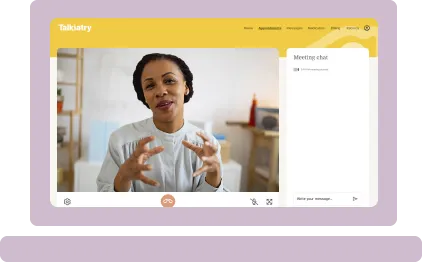
Video can even offer its own window into a patient's life: a psychiatrist evaluating someone for ADHD, for example, might see that their home is in disarray and start a conversation that an office visit would never surface.
Conditions that are usually a good fit for telehealth include:
- Depression
- Anxiety
- ADHD
- OCD
- PTSD
- Bipolar disorder in maintenance
Virtual care also makes it easier to see a psychiatrist in the first place, especially if you live far from an office.⁴
What conditions are not a good fit for telehealth psychiatry?
Telehealth isn't the right fit for psychiatric emergencies, active psychosis or acute mania, substance use that needs medical detox, or conditions that need in-person monitoring. 1,2 What determines this is your situation and how much safety it calls for, not the diagnosis on its own.
Psychiatric emergencies
Telehealth is built for ongoing care, not crisis response. If you’re having thoughts of hurting yourself or someone else, that’s an emergency, and a video visit simply can’t keep you safe in that moment.² Instead, call 911, or call or text 988.⁹
Active psychosis or acute mania
Active psychosis or an acute manic episode can bring on severe agitation or a loss of touch with reality, and it usually needs an urgent in-person evaluation.² This is where a detail about bipolar disorder matters: it’s often managed well through virtual care during steady stretches, but an acute manic or mixed episode may call for in-person care.³
Severe substance use that needs medical detox
Coming off alcohol or benzodiazepines can be medically dangerous, and it needs monitored, in-person detox rather than a routine video visit.¹ Severe substance use disorders can also need more intensive support than telehealth alone can offer.¹
Conditions that need hands-on physical monitoring
Some conditions come with physical information that a video visit can't capture. Eating disorders are the clearest example, because treatment decisions can depend on weight, vital signs, and lab results.² Telehealth psychiatry can work alongside in-person medical monitoring, but it can't replace it. Types of care that only happen in person, like inpatient or residential treatment, are outside what telehealth can safely provide.⁴
When privacy or a stable setup isn't possible
Telehealth needs a private, quiet space and a reliable connection. If you don’t have access to both, a virtual visit may not work well for you.
Is it the diagnosis or the situation that matters most?
It usually comes down to how acute and how safe your situation is, not the diagnosis itself.⁵ A serious but stable diagnosis is often managed well virtually (bipolar disorder in maintenance is a good example), while a sudden crisis with an otherwise milder condition might not be.⁵ That’s why hybrid care is so common: telehealth for regular visits, with in-person care added whenever it’s needed.⁵
{{BLOG_AD}}
Can you get medication, including controlled substances, through telehealth?
Yes. Under current federal rules, psychiatrists can prescribe many medications through telehealth, including certain controlled substances.⁷ The DEA’s Fourth Temporary Extension allows this through December 31, 2026, with no prior in-person visit required, while permanent rules are still being worked out.⁷
Your state may add its own requirements, and some situations still call for in-person steps. Some states require at least one in-person visit before a controlled medication can be prescribed. Controlled substances are also prescribed only after a thorough evaluation, and only when they're the right choice for you.
Do you need an in-person visit before starting telehealth psychiatry?
For most people, no. But the answer depends on your insurance, since this is a coverage question, separate from whether telehealth is a good clinical fit.⁸ Medicare, for example, doesn’t require a prior in-person visit through the end of 2027.⁸ Commercial and Medicaid plans set their own rules, and most currently cover telehealth psychiatry, though what's required and what you'll pay can vary from plan to plan.
Coverage rules have shifted before, too. In October 2025, Medicare’s in-person requirement briefly came back during a policy lapse before being extended again.⁸ You can check your telehealth benefits with your insurer when you sign up.
What should you do if telehealth isn't the right fit?
If telehealth isn't safe or isn't enough, the next step is in-person, hybrid, or a higher level of care, not going without.
In an emergency, call 911, or call or text 988. If it isn't an emergency but still calls for more than a video visit, you have options: in-person psychiatry, an intensive outpatient program, or working with a primary care doctor for monitoring.1,4
Talkiatry checks for fit when you sign up. The assessment matches you with a psychiatrist and helps you understand what kind of care fits your needs. When a situation calls for in-person or more intensive care, a responsible practice will tell you so and point you in the right direction.
The bottom line
Most conditions are a good fit for telehealth psychiatry. It isn't the right fit for psychiatric emergencies, active psychosis or acute mania, substance use that needs medical detox, or conditions that need in-person monitoring. The choice between telehealth and other kinds of psychiatric care comes down to your situation, not the diagnosis alone. And if you're not sure where your situation falls, a psychiatrist can help you figure it out.
Getting started with Talkiatry
Talkiatry is a national psychiatry practice that makes it easier to get care from doctors who listen. Start by answering a few questions online, then get matched with a psychiatrist based on your needs. From there, you can schedule a visit, often within days, and meet with your provider from home. First visits are 60 minutes, so there's time to talk through what's going on and build a treatment plan together. Talkiatry is in-network with most major insurers, and you can check your coverage during the free online assessment.
Take our free online assessment
Medical disclaimer and sources
The information in this article is for informational and educational purposes only and should never be substituted for medical advice, diagnoses, or treatment. If you or someone you know may be in danger, call 911 or the National Suicide and Crisis Lifeline at 988 right away.
- Substance Abuse and Mental Health Services Administration. “Telehealth for the Treatment of Serious Mental Illness and Substance Use Disorders.” 2021. https://library.samhsa.gov/sites/default/files/pep21-06-02-001.pdf
- Uscher-Pines L, et al. “When Is Telemedicine Appropriate?” Psychiatric Services. August 2023. https://pmc.ncbi.nlm.nih.gov/articles/PMC9348900/
- National Institute of Mental Health. “Bipolar Disorder.” 2025. https://www.nimh.nih.gov/health/publications/bipolar-disorder
- Assistant Secretary for Planning and Evaluation. “Understanding the optimal balance of using telehealth and in-person services to support adults with serious mental illness and children with serious emotional disturbance.” November 2024. https://aspe.hhs.gov/sites/default/files/documents/2c955fa57a7b516ed7bf483208a87731/optimal-balance-using-telehealth.pdf
- Uscher-Pines L, et al. “Appropriateness of Telemedicine Versus In-Person Care." Psychiatric Services. January 2022. https://psychiatryonline.org/doi/10.1176/appi.ps.202100519
- American Psychiatric Association. “What is Telepsychiatry?” April 2023. https://www.psychiatry.org/patients-families/telepsychiatry
- Drug Enforcement Administration, Health and Human Services Department. “Fourth Temporary Extension of COVID-19 Telemedicine Flexibilities for Prescription of Controlled Medications.” Federal Register. December 2025. https://www.federalregister.gov/documents/2025/12/31/2025-24123/fourth-temporary-extension-of-covid-19-telemedicine-flexibilities-for-prescription-of-controlled
- Telehealth.HHS.gov. “Telehealth policy updates.” February 2026. https://telehealth.hhs.gov/providers/telehealth-policy/telehealth-policy-updates
Frequently asked questions
Is telehealth psychiatry as effective as in-person care?
For most outpatient conditions, yes. The results match in-person care when it comes to getting a diagnosis, treating the condition, and feeling satisfied with the results.⁶ The main exceptions are situations that need in-person safety monitoring or a physical exam.
Can someone with bipolar disorder use telehealth psychiatry?
Often, yes. Bipolar disorder in maintenance can be managed well through telehealth,⁵ but an acute manic or mixed episode likely needs in-person care.³ Your psychiatrist can help you decide based on what you're going through.
What happens if I have a mental health emergency during a telehealth visit?
Telehealth isn’t set up for mental health emergencies. If you’re in danger, call 911, or call or text 988 right away. A telehealth provider can point you toward emergency care, but they can’t deliver that care themselves.
Can I get controlled substances prescribed through telehealth?
Yes, under current DEA rules through December 31, 2026.⁷ Your state’s laws and your psychiatrist’s clinical judgment still apply.
Can children and teens be treated through telehealth psychiatry?
Often, yes, usually with a parent or guardian present. Talkiatry treats young people ages 5 to 18 through telehealth. Some situations still need in-person care, but a telehealth provider can help you make that call.
Crisis and emergency resources

Call 911
If you’re having a medical or mental health emergency, call 911 or go to your nearest ER.

Call or text 988
If you are in crisis or emotional distress, call or text the 988 Suicide & Crisis Lifeline.
Like this article?
Join our newsletter.
Get regular articles and insights from our psychiatrists directly to your inbox.
See you in your inbox.