What Can a Psychiatrist Prescribe Online vs. In Person?
Online psychiatrists can prescribe most psychiatric medications, including controlled substances in many states. Learn what's different online vs. in person and current 2026 rules.
Key takeaways
- Online psychiatrists can prescribe most of the same medications as in-person psychiatrists, including antidepressants, mood stabilizers, antipsychotics, and (in many states) controlled substances like stimulants for ADHD.
- Some states restrict or ban certain controlled medications via telehealth, requiring an in-person visit even when federal rules don’t require it.
- Online psychiatric visits follow the same clinical standards as in-person care, including a full evaluation, diagnosis, treatment plan, and ongoing medication monitoring.


If you are having a difficult time finding a psychiatrist, telehealth presents a good option for getting the care you need. Online psychiatrists can prescribe most of the same medications as in-person psychiatrists, including antidepressants, anti-anxiety medications, mood stabilizers, and antipsychotics, while offering the added benefits of convenience and a wider pool of providers to choose from.
This matters because access to psychiatric care is a real problem. More than 160 million Americans live in areas with a shortage of mental health providers.1 Nearly half of adults with mental illness still don't receive treatment.2 Online psychiatry helps close that gap by making it possible to see a board-certified psychiatrist from home.
What online psychiatrists can prescribe
Online psychiatrists can prescribe the full range of non-controlled psychiatric medications. In most states, they can also prescribe many controlled medications. The distinction between the two types of medications comes down to their potential for misuse or dependence. Controlled substances have more potential for misuse or dependence, so they are regulated by the DEA and require a closely monitored prescribing process. Non-controlled substances have no such restrictions and can be prescribed more straightforwardly. Regardless of what they prescribe, physicians are still bound by state regulations covering what can and cannot be filled.
Depression and anxiety: Antidepressants are among the most commonly prescribed psychiatric medications, and they can be prescribed through telehealth psychiatrists. SSRIs like sertraline (Zoloft) and escitalopram (Lexapro), along with SNRIs like venlafaxine (Effexor) and duloxetine (Cymbalta), can all be prescribed through a telehealth visit. Non-controlled anti-anxiety medications like buspirone and hydroxyzine are also available online in every state.
Bipolar disorder: Mood stabilizers like lithium, lamotrigine, and valproate are non-controlled medications. Your psychiatrist can prescribe and monitor all of them through online visits. The same goes for atypical antipsychotics like quetiapine (Seroquel), aripiprazole (Abilify), and risperidone, which are used for bipolar disorder, schizophrenia, and treatment-resistant depression. In addition, they can order online the required labs to safely monitor for potential side effects like metabolic syndrome, as well as things like lithium levels that are crucial for managing these medications.
ADHD: Stimulant medications like Adderall, Ritalin, Vyvanse, and Concerta are Schedule II controlled substances. Under current federal rules, they can be prescribed via telehealth in most states.3 Non-stimulant options like Strattera, Intuniv, Qelbree, and Wellbutrin are non-controlled and available online everywhere, making them a good option to explore in states that ban online prescription of stimulants. When using online psychiatry, patients are often responsible for measuring their own vitals as physicians are not able to. This plays an important role in monitoring ADHD medication side effects such as high blood pressure and/or elevated heart rate.
Sleep issues: Non-controlled sleep medications like trazodone and doxepin can be prescribed online without restrictions.
These are the same medications an in-person psychiatrist would prescribe. The clinical evaluation is equivalent. About 23.4% of U.S. adults experience mental illness in a given year,2 and access to these medications (whether online or in-person) is a critical part of treatment.
What requires an in-person visit (and why)
Most psychiatric medications can be prescribed online. The exceptions fall into a few specific categories.
State-specific controlled substance restrictions. Some states ban or limit telehealth prescribing of certain controlled substances, even though federal rules currently allow it. If you live in one of these states, you may need an in-person visit for specific medications. (More on this in the next section.)
Injectable medications. Long-acting antipsychotic injections (like Invega Sustenna or Aristada) require in-office administration. Your psychiatrist can manage the rest of your treatment online and provide referrals for a local provider for injections.
Medications requiring frequent lab work. Clozapine, for example, requires regular blood monitoring. Lithium also needs periodic blood level checks. While an online psychiatrist can prescribe these medications, you'll need to visit a local lab for blood draws.
Complex or high-risk clinical situations. If you're experiencing a psychiatric emergency, such as active suicidality or severe psychosis, in-person assessment may be necessary for safety. Some complex cases may require gathering important data points in person that would be difficult to detect via telehealth. In addition, in-person clinics often have 24/7 on-call coverage and walk-in appointments for urgent matters.
The key distinction: most limitations are regulatory or logistical, not clinical. Your psychiatrist's training and knowledge are the same whether you're meeting on a screen or across a desk.
Controlled substances: the online vs. in-person divide
Under current federal rules (through December 31, 2026), DEA-registered psychiatrists can prescribe Schedule II-V controlled substances via telehealth without requiring an in-person visit first.3
This wasn't always the case. The Ryan Haight Act (2008) normally requires at least one in-person medical evaluation before a provider can prescribe controlled substances remotely.4 Think of it as a gatekeeping rule: one face-to-face visit, then remote prescribing can continue. Since March 2020, temporary flexibilities have waived even that initial visit. The DEA and HHS issued a Fourth Temporary Extension in late 2025, keeping these flexibilities active through the end of 2026.3
The scale of this matters. In 2024, approximately 7 million controlled substance prescriptions were issued via telehealth without a prior in-person evaluation (about 16% of 44.6 million total).3
State rules create the real variation. Most states follow the federal flexibility, but not all:
- Some states (including Alabama, Arkansas, Delaware, Hawaii, Louisiana, Minnesota, and Rhode Island) prohibit telehealth prescribing of controlled substances entirely. (Talkiatry does not currently operate in Hawaii.)
- New Jersey does not permit Schedule II controlled substance prescriptions via telehealth for adults (with a limited exception for patients under 18).⁵
- A handful of other states have specific restrictions on certain controlled substance categories.
Your ability to get a specific controlled substance online depends on which state you live in.
Platform policies also matter. Many telehealth platforms choose not to prescribe controlled substances at all, even where it's legally permitted. That's a business decision, not a medical one. Talkiatry psychiatrists are DEA-registered and can prescribe controlled substances, including stimulants for ADHD, in most of the states where we operate.
{{BLOG_AD}}
How online psychiatric prescribing actually works
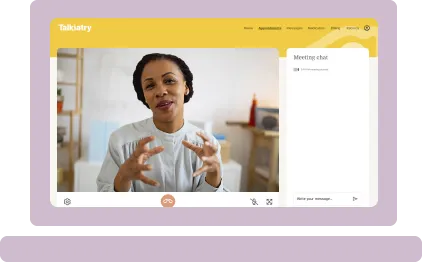
An online psychiatric visit follows the same clinical process as an in-person appointment: evaluation, diagnosis, treatment plan, and prescription.
The process follows four steps.
- Initial evaluation (60 minutes at Talkiatry). Your psychiatrist conducts a full video assessment. You'll discuss your symptoms, medical history, lifestyle, and any current medications. This is the same structured evaluation you'd get in an office visit.
- Diagnosis and treatment plan. Based on the evaluation, your psychiatrist determines whether medication is appropriate and discusses your options. You'll talk through benefits, potential side effects, and what to expect.
- E-prescribing. Your prescription is sent electronically to your pharmacy. You pick it up locally or get it delivered. E-prescribing systems actually reduce medication errors by 13% to 99% compared to handwritten prescriptions.6
- Follow-up visits (30 minutes at Talkiatry). Regular check-ins let your psychiatrist monitor how the medication is working, adjust dosages, and address side effects.
Research supports this model. A large randomized clinical trial at Yale found that telehealth care is equally effective as in-person care for improving quality of life.7 Telepsychiatry also has significantly lower no-show rates than in-person visits, which means more consistent treatment.⁸
At Talkiatry, you can often get an appointment within days. The national median wait to see a psychiatrist is 67 days.⁹
When in-person psychiatry might be the better fit
Online psychiatry works well for most people, but in-person care may be a better choice in specific situations.
You might consider in-person psychiatry if:
- You need an injectable medication. Long-acting antipsychotic injections or IV infusions require in-office administration.
- Your state restricts telehealth prescribing for the specific controlled substance you need.
- You prefer a hands-on neurological examination as part of your initial evaluation.
- You're in a crisis that requires immediate, in-person safety assessment.
Online and in-person psychiatry aren't competing options. Many people use both. You might start with an online anxiety treatment plan for convenience and see someone in person only when the situation calls for it.
The bottom line
Online psychiatrists can prescribe most of the same medications as in-person psychiatrists, including controlled substances in many states under current federal rules (through 2026). The main variable is state law, which determines whether specific controlled substances are available via telehealth. If you're ready to explore whether online psychiatry could work for you, a good first step is checking your coverage and scheduling an evaluation.
Getting started with Talkiatry
Talkiatry is a national psychiatry practice that makes it easier to get care from doctors who listen. Start by answering a few questions online, then get matched with a psychiatrist based on your needs. From there, you can schedule a visit, often within days, and meet with your provider from home. First visits are 60 minutes, so there's time to talk through what's going on and build a treatment plan together. Talkiatry is in-network with most major insurers, and you can check your coverage during the assessment.
Take our free online assessment
Medical disclaimer and sources
The information in this article is for informational and educational purposes only and should never be substituted for medical advice, diagnoses, or treatment. If you or someone you know may be in danger, call 911 or the National Suicide and Crisis Lifeline at 988 right away.
Sources
- Health Resources and Services Administration (HRSA). Designated Health Professional Shortage Areas Statistics. https://data.hrsa.gov/topics/health-workforce/shortage-areas
- Substance Abuse and Mental Health Services Administration (SAMHSA). 2024 National Survey on Drug Use and Health: Annual National Report. 2025. https://www.samhsa.gov/data/report/2024-nsduh-annual-national-report
- Federal Register. Fourth Temporary Extension of COVID-19 Telemedicine Flexibilities for Prescription of Controlled Substances. December 31, 2025. https://www.federalregister.gov/documents/2025/12/31/2025-24123/fourth-temporary-extension-of-covid-19-telemedicine-flexibilities-for-prescription-of-controlled
- U.S. Drug Enforcement Administration. DEA Extends Telemedicine Flexibilities to Ensure Continued Access to Care. December 31, 2025. https://www.dea.gov/press-releases/2025/12/31/dea-extends-telemedicine-flexibilities-ensure-continued-access-care
- American Psychiatric Association. Online Prescribing of Controlled Substances: Ryan Haight Act. Updated 2026. https://www.psychiatry.org/psychiatrists/practice/telepsychiatry/toolkit/ryan-haight-act
- Ammenwerth E, et al. The Effect of Electronic Prescribing on Medication Errors and Adverse Drug Events: A Systematic Review. Journal of the American Medical Informatics Association. 2008;15(5):585-600. https://pubmed.ncbi.nlm.nih.gov/18579832/
- Yale School of Medicine. Telehealth Is Just as Effective as In-Person Care, New Study Finds. October 2024. https://medicine.yale.edu/news-article/telehealth-is-just-as-effective-as-in-person-care-new-study-finds/
- Connolly SL, et al. Telepsychiatry and No-Show Rates: A Systematic Review and Meta-Analysis. Psychiatric Services. 2022. https://pmc.ncbi.nlm.nih.gov/articles/PMC9004215/
- National Council for Mental Wellbeing. The Psychiatric Shortage: Causes and Solutions. 2022. https://www.thenationalcouncil.org/resources/psychiatric-shortage-causes-and-solutions/
Frequently asked questions
Can an online psychiatrist prescribe Adderall?
Yes, in most states. Under current federal rules (through December 31, 2026), DEA-registered psychiatrists can prescribe stimulants like Adderall via telehealth without requiring an in-person visit first.¹ Some states restrict this, so availability depends on where you live. Talkiatry prescribes stimulants in most of the 45 states where we operate.
Do I need an in-person visit before getting medication online?
Under current federal rules, no. The COVID-era telehealth flexibilities (extended through December 31, 2026) allow psychiatrists to prescribe controlled substances without a prior in-person visit.¹ Some states may have additional requirements. For non-controlled medications like antidepressants or mood stabilizers, no in-person visit is required in any state.
Does insurance cover medications prescribed online?
Yes, in most cases. Medications prescribed by a licensed online psychiatrist are filled at a regular pharmacy and covered by your insurance the same way in-person prescriptions are. Talkiatry is in-network with most major insurers, and you can check your coverage during the online assessment.
What's the difference between what you can get online vs. in person?
For non-controlled medications (antidepressants, mood stabilizers, antipsychotics), there's no difference. The distinction matters mainly for controlled substances, where state laws may restrict telehealth prescribing. Injectable medications also require in-person administration. The clinical evaluation itself follows the same standards in both settings.
Are online prescriptions as safe as in-person prescriptions?
Yes. Online psychiatrists follow the same prescribing standards and clinical protocols as in-person providers. E-prescribing systems reduce medication errors by 13% to 99% compared to handwritten prescriptions.6 Follow-up monitoring is equivalent; your psychiatrist tracks your progress and adjusts treatment during regular video visits.
Can online psychiatrists prescribe anxiety medication?
Yes. Non-controlled anxiety medications like buspirone and hydroxyzine can be prescribed online in every state. Controlled anti-anxiety medications (such as benzodiazepines) depend on state rules and your prescriber's policies. Talkiatry psychiatrists work with patients on anxiety every day and can help determine the right medication approach for you.
Crisis and emergency resources

Call 911
If you’re having a medical or mental health emergency, call 911 or go to your nearest ER.

Call or text 988
If you are in crisis or emotional distress, call or text the 988 Suicide & Crisis Lifeline.
Like this article?
Join our newsletter.
Get regular articles and insights from our psychiatrists directly to your inbox.
See you in your inbox.